
Views: 0 Author: Site Editor Publish Time: 2026-04-24 Origin: Site


Ever wondered how machines achieve perfectly straight, high-speed motion without gears? A Magnetic Linear Motor does exactly that, using electromagnetic force instead of mechanical parts. It moves directly along a path, eliminating friction and backlash.
In industries like robotics and semiconductor manufacturing, these motors deliver faster acceleration and micron-level precision.
In this article, you will learn how a Magnetic Linear Motor works, its key components, and why it outperforms traditional linear motion systems.
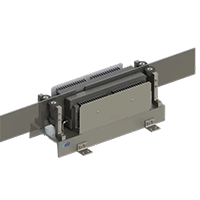
● Direct linear motion: Magnetic Linear Motors convert electrical energy into precise straight-line motion without mechanical transmission.
● High precision and smoothness: Their direct-drive design eliminates friction and backlash, enabling micron-level positioning and smooth acceleration.
● Core components: Key elements include the primary forcer, secondary magnet track, air gap, guidance system, and motion controllers.
● Versatile types: Iron-core, ironless, tubular, and flat designs address different load, precision, and space requirements.
● Performance optimization: Air gap control, feedback systems, and thermal management ensure reliability and efficiency.
● Industrial applications: Widely used in robotics, semiconductor manufacturing, precision inspection, and advanced automation.
● Value proposition: Companies like dlmd provide advanced solutions that enhance efficiency, reduce maintenance, and support high-performance automation.
At the heart of a magnetic linear motor is the Lorentz force principle, where an electric current interacts with a magnetic field to generate motion. In rotary motors, this interaction produces torque around a shaft. A linear motor “unrolls” the rotary concept, translating electromagnetic forces into straight-line thrust.
Linear motors produce continuous motion without mechanical conversion, enabling higher efficiency and precise control. The force direction is determined by the orientation of magnets and current flow, allowing designers to tailor motion profiles for specific applications.
Eliminating mechanical transmission components reduces wear, friction, and backlash. This direct-drive design ensures high repeatability, consistent speed, and smoother acceleration. There are no gears or screws to introduce lag or mechanical hysteresis.
Note: Direct-drive reduces maintenance needs, particularly in high-cycle or cleanroom environments where particulate generation from mechanical parts is a concern.
Magnetic linear motors rely on closed-loop control using linear encoders or magnetic sensors. These systems provide real-time position feedback, allowing controllers to adjust current precisely and maintain the desired trajectory. High-resolution feedback supports sub-micron positioning in demanding applications.
The motor’s thrust is regulated by controlling current amplitude, phase, and sequencing. By synchronizing the current with the magnet layout, it’s possible to achieve smooth acceleration, rapid deceleration, and accurate stopping points along the linear path.
Note: When designing a system, select a controller capable of synchronizing multi-axis linear motors for complex motion profiles.
The primary part, or forcer, carries the windings through which current flows. As current passes, it generates a magnetic field that interacts with the permanent magnets on the secondary part. Heat is an inevitable byproduct, so proper thermal management—through air or liquid cooling—is critical to maintain performance and longevity.
The secondary component contains permanent magnets arranged in alternating poles along the track. Designs may include back iron to concentrate magnetic flux, or ironless tracks to minimize cogging forces. It is typically fixed to the machine frame and defines the maximum travel length of the motor.
A narrow, controlled air gap between the primary and secondary components ensures optimal magnetic interaction. Variations can reduce thrust, lower efficiency, and compromise positioning accuracy. High-precision systems often require micron-level air gap control.
Even without mechanical transmission, magnetic linear motors need guidance systems to maintain stable motion. Linear guides, ball bearings, or air bearings constrain the moving element to the desired path. Proper integration of guidance systems enhances smoothness and load capacity.
Component | Role | Key Considerations |
Permanent Magnets | Provide static magnetic field for thrust | NdFeB magnets are preferred for high energy density; alignment affects force output |
Windings and Coils | Generate dynamic magnetic field | Coil configuration impacts thrust smoothness, thermal behavior, and efficiency |
Drive and Motion Controller | Regulate current to windings | Must support precise current, velocity, and acceleration profiles |
Position Feedback Systems | Provide real-time position data | High-resolution linear encoders enable micron-level precision |
Cooling Systems | Maintain thermal stability | Choice of air vs. liquid cooling depends on current density and continuous operation |
Note: Use high-quality magnets and advanced coil designs for applications requiring ultra-precision motion to reduce force ripple and improve repeatability.
These motors include a steel core to concentrate flux, offering high thrust and heavy load capacity. Cogging forces can occur, but careful control mitigates vibrations. Ideal for industrial automation and machining.
Designed without an iron core, these motors eliminate cogging and provide exceptionally smooth motion, perfect for ultra-precision applications like semiconductor equipment. Lower force density is the main trade-off.
Tubular designs wrap magnets cylindrically around a central shaft, providing balanced magnetic forces and compact form factors. Suitable for vertical motion and space-constrained applications.
Flat motors have planar magnet tracks, allowing scalable stroke lengths and easy integration into large gantry systems. Common in automated production lines.
Single-sided motors are simpler and lower cost, while double-sided designs offer higher force output and improved symmetry, enhancing stability in demanding tasks.
Motor Type | Force Output | Motion Smoothness | Ideal Applications | Notes |
Iron-Core | High | Medium | Heavy-load automation, machining | Cogging may occur |
Ironless | Medium | Very Smooth | Ultra-precision, semiconductor | Lower force density |
Tubular | Medium | Smooth | Space-constrained, vertical motion | Balanced magnetic forces |
Flat | Medium | Smooth | Gantry systems, long stroke | Scalable and modular |
Single-Sided | Low-Medium | Smooth | Cost-sensitive systems | Simpler design |
Double-Sided | High | Smooth | High-stability, high-force | Higher cost |
Accuracy depends on air gap consistency, magnet quality, encoder resolution, and control algorithms. Repeatability ensures the motor returns to exact positions reliably under dynamic loads.
Motor design influences how quickly it can accelerate and decelerate. Iron-core motors excel at high load, while ironless types provide smoother acceleration for delicate tasks.
High current densities generate heat that can degrade performance. Effective cooling and thermal monitoring maintain consistent thrust and prolong motor lifespan.
Force density refers to thrust per unit area. Ironless designs reduce cogging, improving motion smoothness. Optimization balances magnetic material, winding design, and control strategies.
Factor | Impact on Performance | Optimization Strategy |
Air Gap | Thrust, efficiency, accuracy | Precision alignment |
Magnet Quality | Force output, repeatability | Use high-grade NdFeB magnets |
Winding Design | Acceleration, heat generation | Optimize coil layout, cooling |
Feedback System | Precision, repeatability | High-resolution linear encoders |
Thermal Management | Stability, lifespan | Air or liquid cooling |
Magnetic linear motors achieve micron-level positioning at high speeds, essential for wafer handling and lithography systems.
They provide smooth trajectories and rapid response, reducing mechanical wear and downtime in high-cycle robotic systems.
High-resolution feedback enables accurate inspection of manufactured parts, supporting quality assurance in critical industries.
Multi-axis integration allows synchronized linear motion across production lines, enhancing throughput and process control.
Note: Magnetic linear motors are especially valuable in industries where precision, speed, and minimal maintenance directly impact productivity and ROI.
Magnetic linear motors convert electrical energy directly into linear motion with high precision and smooth acceleration. Their direct-drive design eliminates friction and reduces maintenance. Companies like dlmd provide advanced magnetic linear motors that deliver reliable performance and versatile solutions for automation and high-precision applications. Understanding motor types, feedback systems, and control strategies ensures optimal system efficiency and long-term value.
A: A Magnetic Linear Motor is a direct-drive device that produces linear motion using electromagnetic forces, eliminating gears, belts, or screws.
A: It converts electrical current into linear thrust by interacting with permanent magnets, creating precise motion along a straight path.
A: It offers higher precision, smoother acceleration, minimal friction, and lower maintenance compared to mechanical transmission systems.
A: Key parts include the primary forcer with windings, a secondary magnet track, air gap, guidance system, and motion controllers.
A: They are widely applied in robotics, semiconductor manufacturing, precision inspection, and automated production lines for high-speed, accurate motion.
A: Air gap consistency, magnet quality, winding design, feedback systems, and thermal management all influence precision and efficiency.
A: Costs vary by type, stroke length, and precision requirements, but they offer long-term savings due to reduced maintenance and high reliability.
A: Check alignment, air gap, encoder signals, and current supply. Proper cooling and control settings help maintain smooth operation.


 English