
Views: 0 Author: Site Editor Publish Time: 2026-03-03 Origin: Site


A live roller conveyor is a material handling system designed to move products along a production line or distribution center. Unlike traditional gravity-fed roller conveyors, live roller conveyors use powered rollers, typically driven by motors, to move materials more efficiently and at adjustable speeds. These conveyors are ideal for industries that handle heavy, bulky, or irregularly shaped items that require smooth, controlled transport.
In this article, we will explore the fundamental aspects of live roller conveyors, including how they work, their advantages, applications, and common maintenance practices.
A roller conveyor is a system that uses rollers to move materials along a horizontal or inclined path. The rollers are typically mounted on frames and can be powered by gravity, a belt, or an electric motor. Roller conveyors are widely used in material handling applications because they provide an efficient, low-friction solution for moving goods across warehouses, factories, and distribution centers.
Roller conveyors are distinct from other conveyor types, such as belt conveyors and chain conveyors, in how they transport materials:
Feature | Roller Conveyor | Belt Conveyor | Chain Conveyor |
Material Transport | Rollers (powered or gravity-fed) | Flexible belt moves materials | Chains transport heavy items |
Suitable Loads | Light to medium loads | Light to heavy loads | Heavy or bulky loads |
Speed Control | Adjustable through motor control | Adjustable but limited | Fixed or adjustable based on load |
Maintenance | Low, with occasional roller replacement | Moderate, due to belt wear | High, requires frequent maintenance due to chain wear |
Roller conveyors work by utilizing rollers mounted on frames. Items placed on the rollers move when either gravity or a motor drives the rollers. In live roller conveyors, powered rollers are typically connected to a drive mechanism, such as a motorized belt or chain, to move materials efficiently along the conveyor system.
A live roller conveyor differs from traditional roller conveyors by utilizing powered rollers to move materials. In this system, the rollers are driven by an electric motor connected to a drive mechanism, typically a belt or chain. The motor’s power is transferred to the rollers, allowing them to rotate and move the items placed on them. This method of powered movement makes live roller conveyors particularly effective for handling heavier, irregularly shaped, or larger items that require more precise control over speed and flow. Compared to gravity-driven conveyors, which rely solely on the force of gravity to move items, live roller conveyors offer greater flexibility, reliability, and the ability to operate on flat or inclined surfaces.
The fundamental operation of a live roller conveyor is similar to that of a traditional roller conveyor: materials are placed on rollers, which move them along the conveyor system from one point to another. However, unlike gravity-based roller conveyors, live roller conveyors have powered rollers driven by motors, belts, or chains. These powered rollers rotate continuously, pushing or pulling items along the conveyor path.
In most live roller conveyor systems, an electric motor drives a belt or chain, which is connected to sprockets or pulleys attached to the rollers. As the motor turns the belt or chain, this motion is transferred to the rollers, causing them to rotate. The rotation of the rollers then moves the materials along the conveyor, enabling them to travel from one end of the system to the other. The speed and direction of the rollers can often be adjusted depending on the application requirements, making live roller conveyors ideal for a variety of industries where precise control of material handling is crucial.
A live roller conveyor system is made up of several essential components that work together to provide efficient material movement:
Powered Rollers:
The core of the system, these rollers are powered by a drive mechanism, such as a belt or chain, to rotate and transport materials. Powered rollers are available in various sizes and configurations to accommodate different types of materials and load capacities.
Drive Mechanism:
The drive mechanism connects the motor to the rollers. Typically, this consists of either a belt or chain that transmits power from the motor to the sprockets or pulleys on the rollers. The drive mechanism is crucial for ensuring that the rollers operate smoothly and at the desired speed.
Sprockets or Pulleys:
These components play a critical role in transferring motion from the drive mechanism (belt or chain) to the rollers. Sprockets are used in chain-driven systems, while pulleys are used for belt-driven systems. The interaction between the sprockets/pulleys and the rollers causes the rollers to rotate and move materials along the conveyor.
Frame:
The frame supports all the components of the conveyor, including the rollers, drive mechanism, and motor. It provides structural integrity and ensures that all components remain aligned and securely in place during operation.
Motor:
The motor powers the entire conveyor system. It drives the belt or chain that, in turn, powers the rollers. The motor is typically an electric motor and can be equipped with variable-speed drives for adjusting the speed of the conveyor based on operational needs.
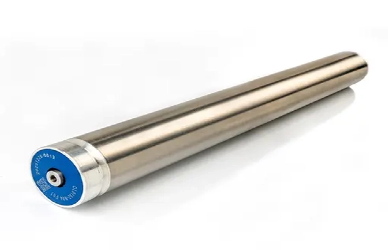
Live roller conveyors are ideal for transporting heavy, bulky, and irregularly shaped materials. Unlike gravity conveyors, which require a continuous slope, live roller conveyors can move items horizontally or even vertically. The powered rollers ensure that products, such as large boxes, crates, and pallets, move steadily and without slipping, even when the load is heavy or unevenly distributed.
Live roller conveyors are highly efficient due to the powered rollers, which provide consistent movement, regardless of the weight or shape of the items being transported. This makes them more reliable than gravity conveyors, which may struggle with heavier or bulkier loads.
Compared to other systems like chain conveyors, live roller conveyors require less maintenance. The rollers themselves are typically low-maintenance, and the only regular maintenance needed is to inspect the motor, belt, or chain. Additionally, they are cost-effective, especially for businesses that need to move materials across a flat or inclined surface without heavy-duty requirements.
Live roller conveyors are versatile and can be easily adapted to handle various materials, including boxes, bags, trays, and pallets. With adjustable speeds, they can be fine-tuned for different products or operational needs.
Live roller conveyors are used in various industries that require efficient material handling systems. Some common applications include:
Warehouses: Used for sorting, packaging, and transporting products in distribution centers.
Manufacturing: Ideal for moving parts between workstations on assembly lines.
Food and Beverage: Used for transporting food items, bottles, or containers.
E-Commerce: Essential for order fulfillment, especially in large distribution centers handling high volumes of products.
Regular Inspection: Check for wear and tear on the rollers, belts, and motors. Ensure that all parts are functioning smoothly.
Belt Tension: Adjust the tension of the belt regularly to avoid slippage or over-tightening.
Lubrication: Ensure that rollers and bearings are properly lubricated to reduce friction and extend lifespan.
Cleanliness: Keep the conveyor clean from debris that can obstruct rollers and affect performance.
Belt Slippage: This can occur due to loose tension or wear. Re-tightening or replacing the belt can resolve this.
Misalignment: Misaligned rollers or belts can cause uneven movement and premature wear. Realigning components ensures smooth operation.
Motor Failure: Regularly check the motor for signs of wear. If the motor is malfunctioning, it may need to be replaced or repaired.
A live roller conveyor uses powered rollers driven by motors or belts, while gravity roller conveyors rely on gravity to move materials.
Live roller conveyors are ideal for heavy, bulky items such as pallets, crates, and large boxes.
Yes, live roller conveyors can be used on inclines, and powered rollers ensure that materials move smoothly, even on slopes.
Regularly inspect and clean rollers, check belt tension, lubricate bearings, and ensure the motor and drive system are functioning properly.
The future of live roller conveyors is closely linked to advancements in automation and smart technology integration. As industries move towards more automated systems, live roller conveyors will increasingly incorporate IoT sensors and predictive maintenance technologies. These innovations will enable real-time monitoring of conveyor performance, allowing for automatic adjustments to optimize efficiency and reduce downtime. With the ability to predict and address potential issues before they arise, these technologies will extend the lifespan of the conveyor systems and improve overall reliability.
The impact of automation on conveyor systems will be profound, particularly with the rise of robotics and AI-driven sorting technologies. These automated systems will provide precise control over the movement and sorting of materials, enabling higher throughput, enhanced flexibility, and greater operational efficiency. As live roller conveyors continue to integrate with such technologies, their role in material handling will evolve, offering more intelligent, adaptable, and cost-effective solutions for industries across the globe.


 English