
Views: 0 Author: Site Editor Publish Time: 2026-07-03 Origin: Site


Engineers and procurement teams face a critical dilemma when specifying drive components today. Selecting the right drive mechanism fundamentally shapes your entire system architecture. It is no longer just a default choice dictated by building power supplies. You must weigh technical tradeoffs carefully. Whether designing a zero-pressure accumulation (ZPA) conveyor system or specifying shades for massive commercial windows, this choice matters. The AC versus DC decision dictates your safety protocols. It also directly influences wiring complexity and control granularity. A mismatched drive often leads to premature hardware failure or overly complex software integration. This guide strips away marketing claims entirely. We provide a hard-nosed, technical comparison between AC and DC options. We base this analysis strictly on implementation realities and physical performance limits. You will learn exactly how duty cycles, zoning needs, and existing infrastructure should guide your final engineering selection.
Internal motor architecture drives every performance metric. AC induction motors rely on alternating current to generate a rotating magnetic field. They inherently lack physical brushes. This brushless design makes them highly durable under constant loads. DC motors utilize permanent magnets and electronic commutation. Modern industrial applications almost exclusively use brushless DC (BLDC) technology.
Heat dissipation remains the primary engineering concern inside a sealed metal tube. An AC motorized roller handles thermal buildup exceptionally well. The metal casing acts as an efficient heat sink for the stator.
The AC profile operates directly from standard line voltage. Facilities typically supply 110V or 220V directly to the unit. You control motor speed by altering the electrical frequency.
The DC profile requires stepped-down power. Most commercial setups utilize 12V or 24V power supplies. You achieve precise speed and torque control by modulating voltage and current. This modulation happens through sophisticated external control cards.
We must check a common industry assumption here. Many technicians assume AC always delivers superior strength. This is fundamentally false. Modern BLDC technology achieves exceptional torque-to-size ratios. A compact 24V DC unit can easily match older AC units in peak torque. However, AC technology remains the dominant standard for raw, continuous bulk movement.
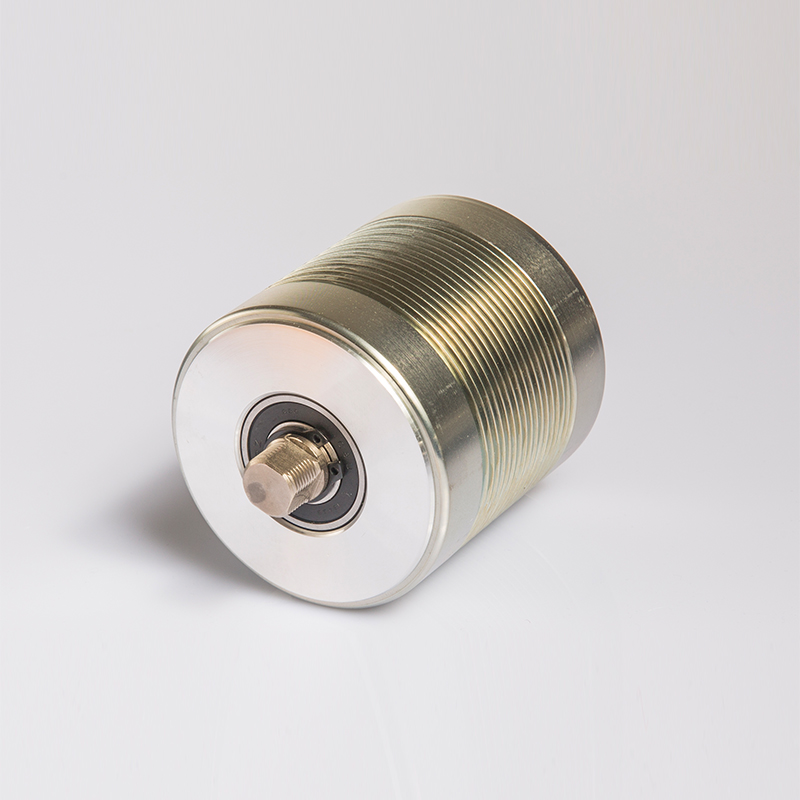
Continuous duty cycles define heavy industrial operations. AC motors excel in these exact environments. They manage internal heat better during always-on states. Bulk material handling relies heavily on this thermal stability. Massive commercial architectural blinds also benefit from this continuous run capability.
Electrical realities dictate physical infrastructure. Long cable runs plague large logistics facilities. DC cables suffer significant voltage drops over long distances. Running 120V or 240V AC eliminates this specific issue entirely. You can power an extensive line of units from a single central breaker panel without losing mechanical force.
Simplicity matters in rugged environments. Some applications simply need an on-and-off state. They move payloads at one fixed, predictable speed. AC drives avoid complex digital control cards. They eliminate unnecessary logic boards from the electrical cabinet.
We must acknowledge specific limitations, however. Native dynamic braking is completely absent in basic AC setups. You must install Variable Frequency Drives (VFDs) if your process requires speed modulation. Adding VFDs increases panel footprint and introduces programming complexity.
Electrical Specifications Breakdown
| Parameter | AC Induction Motors | Brushless DC Motors |
|---|---|---|
| Voltage Supply | 110V / 220V / 480V | 12V / 24V / 48V |
| Distance Tolerance | Excellent (Minimal Drop) | Poor (High Drop over distance) |
| Continuous Duty | Superior Thermal Management | Moderate (Requires specific cooling) |
| Speed Control Native | No (Requires VFD) | Yes (Via PWM controller) |
Modern intralogistics rely heavily on digital zoning. A 24V DC motorized roller serves as the central nervous system for Zero Pressure Accumulation (ZPA). DC systems pair natively with onboard logic cards. They create highly intelligent zones. Packages move smoothly down the line without colliding.
Safety compliance heavily favors DC installations. Global electrical standards classify 12V and 24V systems as Safety Extra Low Voltage (SELV).
Acoustics matter greatly in commercial environments. DC motors run noticeably quieter than induction alternatives. They offer programmable, smooth ramp-up and ramp-down profiles. This specific acoustic profile proves critical for office window blinds. Quiet warehouse picking zones also demand lower decibel outputs.
Implementation risks revolve entirely around power management. DC relies heavily on external power supplies. An under-specified power unit will cause the entire system to fail under peak loads. Engineers must calculate total simultaneous peak amperage carefully before specifying the transformer.
Hardware deployment varies drastically between the two technologies. AC units strictly require licensed electricians for installation. High-voltage hardwiring demands strict adherence to local electrical codes. Conversely, DC units allow safe, plug-and-play installation. General technicians can deploy them quickly using standardized low-voltage cables.
Infrastructure dictates your deployment timeline. AC setups need rigid metal or PVC conduit. They require heavy-duty mechanical contactors. High-voltage relays occupy significant space in control cabinets. Creating reversing circuits adds physical wiring complexity.
DC setups require localized power supplies distributed along the line. They use specialized digital control cables. They integrate easily with modern network gateways. You can connect them directly to PROFINET or EtherCAT in warehouses. You can link them to Zigbee or Z-Wave for residential automation.
Maintenance profiles differ significantly over time. AC relays experience physical mechanical wear. The metal contacts pit and degrade after thousands of cycles. DC controllers use solid-state electrical components. MOSFETs handle power switching without any physical movement. Brushless DC motors offer incredible mechanical longevity. The digital control cards, however, remain susceptible to sudden electrical surges.
You need a verifiable checklist to map drive features to actual business outcomes. Follow these criteria before finalizing your hardware specification.
Application Matrix Chart
| Scenario | Primary Requirement | Recommended Drive | Why It Works |
|---|---|---|---|
| Industrial Bulk Transport | Continuous heavy pallet movement | AC Drive | Handles immense thermal loads and continuous fixed-speed operation seamlessly. |
| Logistics Sortation | Variable speed and routing | DC Drive | Allows digital zoning and ZPA integration for zero-collision package handling. |
| Commercial New Build Blinds | Extreme fabric weights | AC Drive | Leverages existing hardwired building infrastructure without voltage drop. |
| Smart Home Retrofit | Silent operation and automation | DC Drive | Integrates natively with low-voltage protocols and provides silent soft-starts. |
Scenario A focuses on industrial material handling. You should choose AC drives if you move heavy pallets continuously. They handle single-speed bulk transport effortlessly. You should choose DC drives for sortation and accumulation. They dominate in variable speed package routing applications.
Scenario B covers commercial and residential automation. Choose AC drives for extreme window dimensions. They handle heavy fabric weights perfectly when hardwiring infrastructure already exists. Choose DC drives when retrofitting existing spaces. They integrate beautifully with precise smart-home protocols. They prioritize silent operation.
Selecting the optimal drive mechanism requires abandoning default assumptions. The choice between an AC drive and a DC variant is a choice between raw, continuous infrastructure and intelligent, modular control. AC thrives in heavy, fixed-speed, long-distance runs. DC dominates in precise, low-voltage, highly networked environments.
Audit your specific payload requirements carefully. Map out your exact weight constraints and dimensions. Assess your available control infrastructure thoroughly. Determine your low-voltage readiness before ever requesting vendor specifications or issuing RFQs. Proper upfront evaluation prevents costly deployment failures.
A: Yes, it is entirely possible. However, it requires intermediate bridging hardware. You must install smart relays, VFDs, or specialized motor-controller interfaces. This adds significant latency and physical complexity compared to natively digital DC systems.
A: Generally, yes. DC brushless motors utilize pulse-width modulation for operation. This allows for soft start and soft stop programming. It entirely eliminates the mechanical clunk and low-frequency hum associated with AC motor engagement.
A: DC systems suffer from severe voltage drop over long electrical distances. You must place power supplies very close to the drive. AC systems sustain long cable runs directly from a central breaker without experiencing performance degradation.
A: Both formats offer extensive mechanical lifespans, often exceeding 50,000 hours. AC motors are highly robust with fewer electronic components to fail. BLDC motors eliminate physical brush wear but rely heavily on the durability of external control cards.


 English