
Views: 0 Author: Site Editor Publish Time: 2026-06-29 Origin: Site


Modern logistics facilities are rapidly moving away from massive, centralized AC motor drives. They now favor decentralized, zone-controlled automation architectures. This fundamental shift handles complex sorting needs while actively conserving energy. The critical component making this reality possible is the DC motorized roller. It enables seamless Zero-Pressure Accumulation (ZPA) and creates highly scalable sorting zones across expansive warehouse floors.
Choosing the right hardware is not simply about picking a popular brand. You must carefully match torque, speed, control logic, and environmental ratings to your specific payload and throughput realities. High initial component costs demand a rigorous evaluation process. Miscalculating starting torque or ignoring PLC handshake requirements will quickly derail your conveyor design.
In this guide, you will learn how to evaluate voltage and gearing configurations for different payloads. We will explore network integration, address common deployment risks like voltage drop, and provide a clear framework for shortlisting vendors.
Traditional continuous-run AC systems represent brute force engineering. A single large motor drives a massive belt or chain, moving every roller simultaneously regardless of actual package volume. This wastes immense amounts of energy. It also generates significant noise pollution, creating harsh working environments for fulfillment center employees.
In contrast, a decentralized motorized roller system operates on a run-on-demand basis. Integrated sensors detect a package entering a specific zone. The local roller activates just long enough to advance the payload, then powers down. This zone-by-zone logic ensures packages never collide, achieving perfect Zero-Pressure Accumulation.
To declare a deployment successful, you should look for specific criteria:
You must maintain a skeptical check during the design phase. DC rollers carry a higher initial component cost than simple AC systems. You must justify this upfront investment through proven energy savings, vastly reduced maintenance downtime, and modular scalability. When a single roller fails, you replace it in minutes. An AC chain failure halts the entire line.
Understanding hardware categories prevents severe over-engineering. You must align the roller's internal physics with your facility's physical demands. The first major decision involves selecting the operational voltage.
Voltage dictates current flow. Current dictates heat generation and cable sizing.
24V DC: This remains the industry standard for lightweight to medium parcels. E-commerce fulfillment, apparel sorting, and standard polybag handling rely heavily on 24V architecture. Power supplies are ubiquitous, and control cards are highly standardized.
48V DC: This is the emerging standard for high-torque requirements. Handling heavy pallets or executing high-speed merges demands more mechanical power. Delivering this power at 24V requires massive current, which generates excessive heat. A 48V system draws half the current for the same power output. This reduces cable thickness over long conveyor runs and prevents dangerous voltage drops.
Internal gearing transforms raw motor speed into usable mechanical force. Your choice depends on the application.
Planetary Geared Rollers: These feature intricate internal gearboxes. They produce high torque at standard conveyor speeds. You will use these for heavy accumulation zones where frequent stop-and-start actions require massive breakaway force to move stationary boxes.
Gearless (Direct Drive) Rollers: These lack internal reduction gears. The motor drives the tube directly. They offer extremely high speed but very low torque. You should reserve gearless designs for rapid sorting lanes handling low-mass items like padded envelopes or empty totes.
Modern conveyor automation focuses exclusively on Brushless DC (BLDC) motors. Legacy brushed models suffer from mechanical friction. Brushes wear down, creating carbon dust and eventually failing. BLDC motors use electronic commutation. Magnets rotate around a stationary stator. This eliminates physical contact, drastically extending lifespan and minimizing maintenance.
| Specification | 24V DC Architecture | 48V DC Architecture |
|---|---|---|
| Optimal Payload | Light to Medium (up to 35kg/zone) | Heavy (Pallets, large loads > 35kg) |
| Cable Gauge Requirement | Thicker (due to higher current draw) | Thinner (half the current for same power) |
| Daisy-Chain Distance | Shorter (susceptible to voltage drop) | Longer (better voltage stability over distance) |
| Primary Application | E-commerce, polybags, standard totes | Beverage distribution, heavy manufacturing |
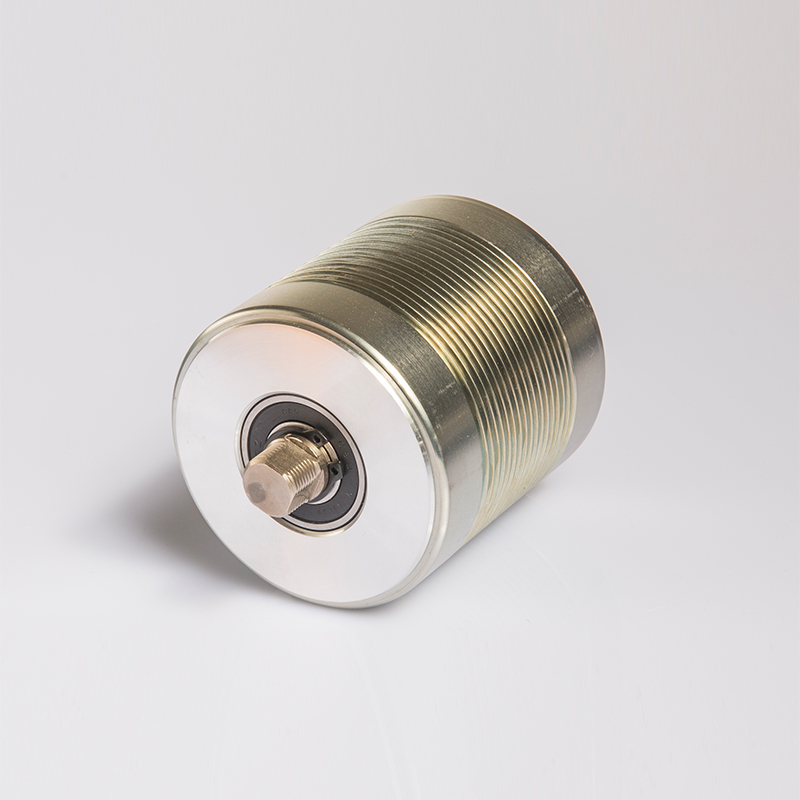
Translating vendor datasheets into real-world outcomes requires technical scrutiny. You must bridge the gap between idealized laboratory tests and brutal warehouse realities.
Never rely on vendor "ideal condition" claims when calculating torque. A roller might boast a high running torque, but starting torque is what actually matters. When a heavy box sits in a ZPA zone, the system must overcome static friction to move it.
You must calculate the required starting torque based on your maximum payload friction. Cardboard on zinc-plated steel has a different friction coefficient than a plastic tote on a polyurethane-sleeved tube. Calculate the tangential force required at the roller's surface. Ensure the rated starting torque exceeds this force by at least a 20% safety margin. If the roller stalls, the package jams.
Evaluating speed curves is vital for consistent sorting. Most BLDC rollers offer adjustable speeds via DIP switches or digital inputs. However, changing loads impact performance. A roller driving a 5kg box at 1 meter per second might slow down significantly when suddenly asked to drive a 30kg box.
Examine the control card's PID (Proportional-Integral-Derivative) loop capabilities. High-quality controllers actively monitor motor Hall effect sensors. They dynamically adjust current to maintain a constant sorting speed regardless of payload fluctuations. This prevents timing errors downstream at diverters and shoe sorters.
A motorized unit rarely works alone. It typically drives several adjacent idler rollers. The transmission method determines how effectively it transfers power.
| Transmission Type | Torque Transfer | Maintenance Complexity | Best Use Case |
|---|---|---|---|
| Poly-V Belt | High | Moderate | Heavy loads, standard accumulation |
| O-Ring | Low | Low | Lightweight parcels, budget setups |
| Timing Belt | Very High (Zero slip) | High | Precision indexing, robotic cells |
Specifying the wrong Ingress Protection (IP) rating guarantees premature mechanical failure. Standard logistics facilities usually require IP54 ratings. This protects against general warehouse dust and minor splashes.
Food processing or pharmaceutical applications demand IP66 or IP67 ratings. These units withstand high-pressure chemical washdowns. Furthermore, check operating temperature limits. Cold-storage environments require specialized lubricants. Standard grease freezes at -20°C, stalling the internal planetary gears completely.
Mechanical specifications only solve half the puzzle. Implementation failures usually stem from electrical and network oversights. You must treat these units as connected IT devices, not just mechanical actuators.
Every motorized tube requires a control module. Some manufacturers integrate this card directly inside the roller tube. This saves space but exposes sensitive electronics to internal motor heat. It also makes replacement difficult.
External control modules mount onto the conveyor side frame. They offer better thermal dissipation and immediate diagnostic LED visibility. However, the true risk lies in the PLC handshake. Ensure your chosen control cards offer native compatibility with your facility's industrial protocols. Whether you use EtherCAT, Ethernet/IP, or PROFINET, the hardware must integrate without requiring excessive, latency-inducing middleware.
Undersized power supplies represent the most common deployment failure. Engineers often calculate average power draw instead of peak starting draw. When a 20-zone conveyor line restarts simultaneously after a jam, the massive current spike triggers power supply safety shutdowns.
Voltage drop further complicates this. Daisy-chaining too many control cards over long distances causes the voltage to degrade. A 24V supply might only deliver 19V by the end of the line. This leads to stalled zones and erratic sensor behavior. You must calculate wire gauge limits and strategically inject auxiliary power along extended conveyor lengths.
Continuous sorting generates immense heat. ZPA logic dictates that motors run intermittently. If throughput demands force a zone to run continuously, you exceed the motor's designed duty cycle.
Excessive heat degrades internal electronics and melts planetary gear lubricants. Over-speccing thermal protection is a necessary insurance policy. Ensure your control cards feature auto-throttling or thermal shutdown limits. It is better to temporarily halt a zone than to permanently burn out the motor coils.
Navigating vendor catalogs requires a disciplined approach. Do not start by comparing prices. Start by filtering out hardware unable to survive your operational environment. Follow this systematic shortlisting logic.
Step 1: Define the extreme payload. Find the heaviest, most awkwardly shaped item in your product mix. Calculate its friction coefficient against a steel tube. Filter out any rollers that cannot handle this peak starting torque comfortably. Do not base your decision on your "average" box.
Step 2: Map the network architecture. Consult your controls engineers. If your facility runs purely on Allen-Bradley PLCs, you need native Ethernet/IP support. Eliminate vendors lacking downloadable Add-On Instructions (AOIs) or native support for your specific WCS/PLC protocols. Middleware creates unacceptable sorting delays.
Step 3: Evaluate MTBF and Warranty. Marketing brochures often exaggerate lifespan. Look for transparent, verifiable Mean Time Between Failures (MTBF) data. Demand engineering test reports showing how they achieved those numbers. Ask under what specific duty cycles the warranty remains valid.
Step 4: Request a Proof of Concept (PoC). Never commit to a facility-wide rollout based on paper specifications. Request a minimum viable zone setup. Build a 3-5 zone accumulation test lane in your maintenance shop. Run your heaviest payloads through it. Monitor the motor temperature, test the photo-eye logic, and verify the PLC handshake.
Choosing the correct equipment follows a strict decision framework: calculate payload torque, define speed curves, verify control network compatibility, and engineer robust power infrastructure. Skipping any of these steps compromises the entire logistics operation.
The modern sorting facility relies on granular, intelligent movement. The right equipment acts as both a mechanical actuator and a data-gathering edge device, feeding critical operational metrics back to your warehouse software. It is an investment in long-term operational resilience.
Before you request a single vendor quote, walk your facility floor. Audit your current conveyor friction levels. Document the precise protocols your PLC network requires. By defining your extreme operational boundaries first, you guarantee a seamless, high-performance automation upgrade.
A: The primary differences involve payload capacity, wiring efficiency, and power supply distances. A 48V system draws half the current of a 24V system to produce the same mechanical power. This reduces heat generation and allows you to use thinner cables. It also prevents severe voltage drops over long conveyor runs, making 48V ideal for heavy pallet handling and high-speed applications.
A: Yes. A single unit typically drives up to 6-10 adjacent idler rollers to form a single sorting zone. The exact number depends on the total zone weight and the drive transmission method. Poly-V belts transfer torque far better than standard O-rings, allowing a single motor to confidently drive heavier accumulation zones without belt slippage.
A: You control them via integrated or external motor control cards wired directly to localized photo-eye sensors. These cards feature built-in logic to manage zone accumulation automatically. They communicate with upstream and downstream zones to prevent box collisions. This localized control handles real-time spacing without requiring a central PLC to make every individual stop-and-start decision.
A: When properly specified, a high-quality brushless unit provides a realistic lifespan of 15,000 to 25,000+ run hours. Because they operate on a run-on-demand duty cycle, this often translates to many years of warehouse operation. However, continuously over-torquing the motor beyond its rated capacity or ignoring thermal limits will easily cut this lifespan in half.


 English